Get free quotes from drone inspection near you
Takes about a minute. Free, no obligation; providers reply to you directly.
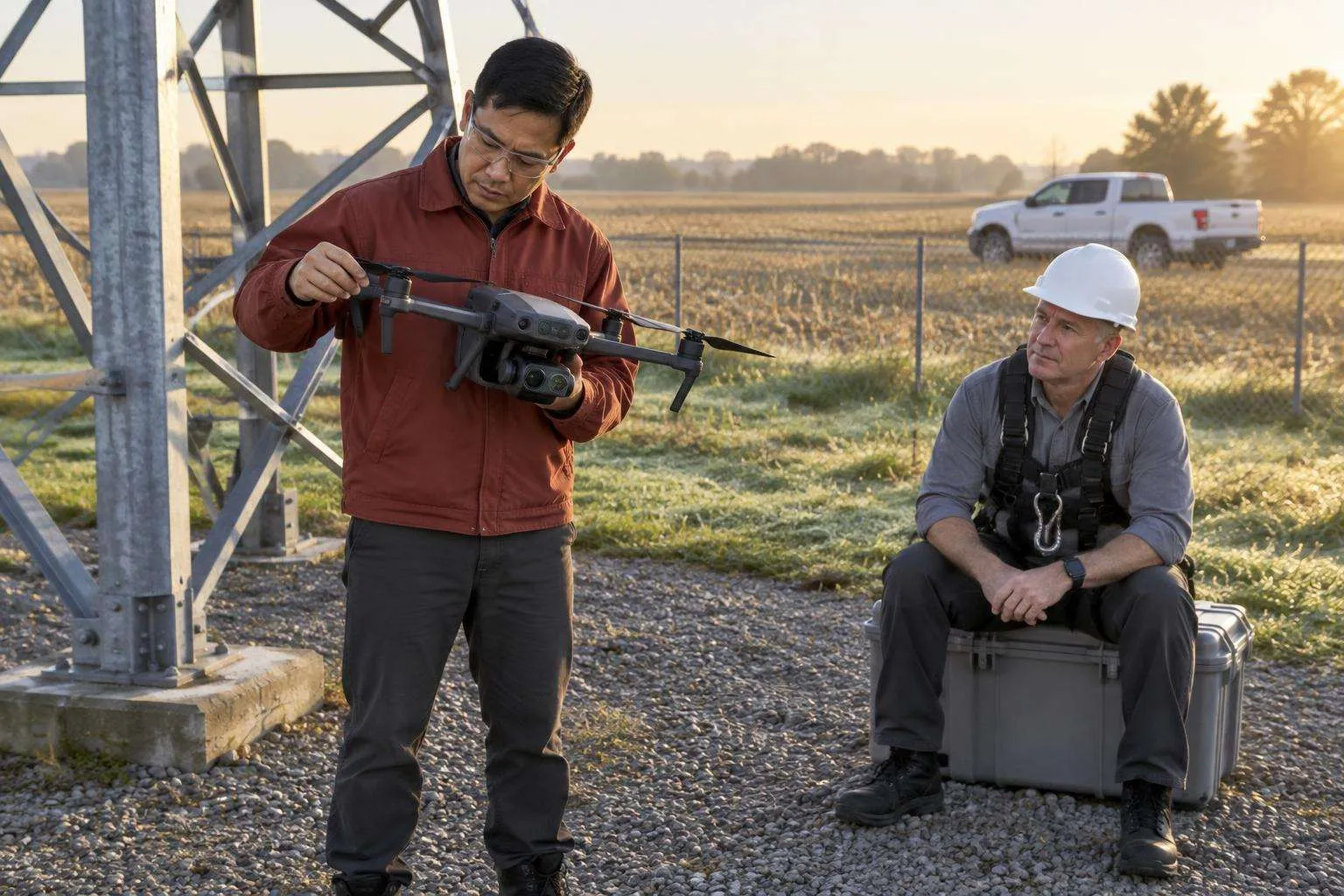
The project manager called me an hour after the inspection wrapped. His tower crew had climbed back up anyway — a full rope-access job — because the drone footage showed the antenna mounting bolts just fine, but the thermal camera had never been calibrated that morning. Three hours of imagery, completely useless for what they actually needed.
That one conversation taught me more about drone inspections than any FAA study guide.
The Short Version:Most drone inspection failures — on both the hiring side and the provider side — aren’t hardware problems. They’re process problems. Pre-flight discipline, GCP placement, battery management, and clear deliverable specs prevent about 80% of expensive do-overs.
Key Takeaways:
- 80% of drone crashes among new commercial pilots trace back to RTH mishandling, not skill deficits
- Measurement errors exceeding 0.1ft typically come from compass/barometer calibration failures, not data processing
- Clients cause as many problems as operators — vague scopes and last-minute weather waivers top the list
- Battery and flight-path planning aren’t optional on industrial jobs; they’re the job
For the full picture of how drone inspection services work and what you should expect from a professional engagement, start with The Complete Guide to Drone Inspection Services.
1. Skipping the Pre-Flight Checklist
What happens: The operator powers up, does a visual scan, and launches. Somewhere in the first ten minutes, the GPS lock drops, the compass throws an error, or a loose prop causes a mid-air vibration that blurs every frame from that altitude band.
Pre-flight checks — battery health, prop torque, sensor calibration, GPS signal count, compass calibration — aren’t busywork. They catch the failure before the failure happens. On every flight.
Pro Tip:Ask your operator for their pre-flight checklist before you hire them. A real commercial operation has a written one. If they can’t produce it, that tells you something.
2. GCP Placement Done Wrong (or Not at All)
What happens: The survey looks beautiful in the flight software. Then it goes into photogrammetry processing and the geo-rectification fails — or worse, it succeeds but introduces drift you don’t catch until you’re cross-referencing with actual site measurements.
Ground Control Points need to be distributed evenly across the site including edges, elevation changes, and treelines. Missing the edges is the classic mistake. Absent edge coverage, the software has no anchor and the model warps. Skylark Drones documented this pattern repeatedly — no edge GCPs means unknown accuracy, full stop.
Reality Check:Measurement errors exceeding 0.1ft in drone surveys almost always trace back to GCP gaps or compass/barometer calibration issues — not your processing software. Fix the field problem first.
3. Misunderstanding Return-to-Home Triggers
What happens: The operator lands the drone, walks toward it, and it takes off again. Or it’s in the middle of a confined-space pass and low-battery RTH kicks in, pulling it straight into a structure.
RTH logic is model-specific and notoriously counterintuitive. On some platforms, the low-battery RTH fires at just 20 meters distance. If the operator didn’t cancel RTH after touchdown, a second auto-takeoff follows. Industry data puts 80% of new commercial pilot crashes in the RTH/takeoff/landing failure bucket — not dramatic mid-flight incidents.
Know your drone’s RTH behavior. Cancel it manually when you’ve landed. Don’t treat autonomous recovery as a safety feature you don’t need to understand.
4. Battery Management as an Afterthought
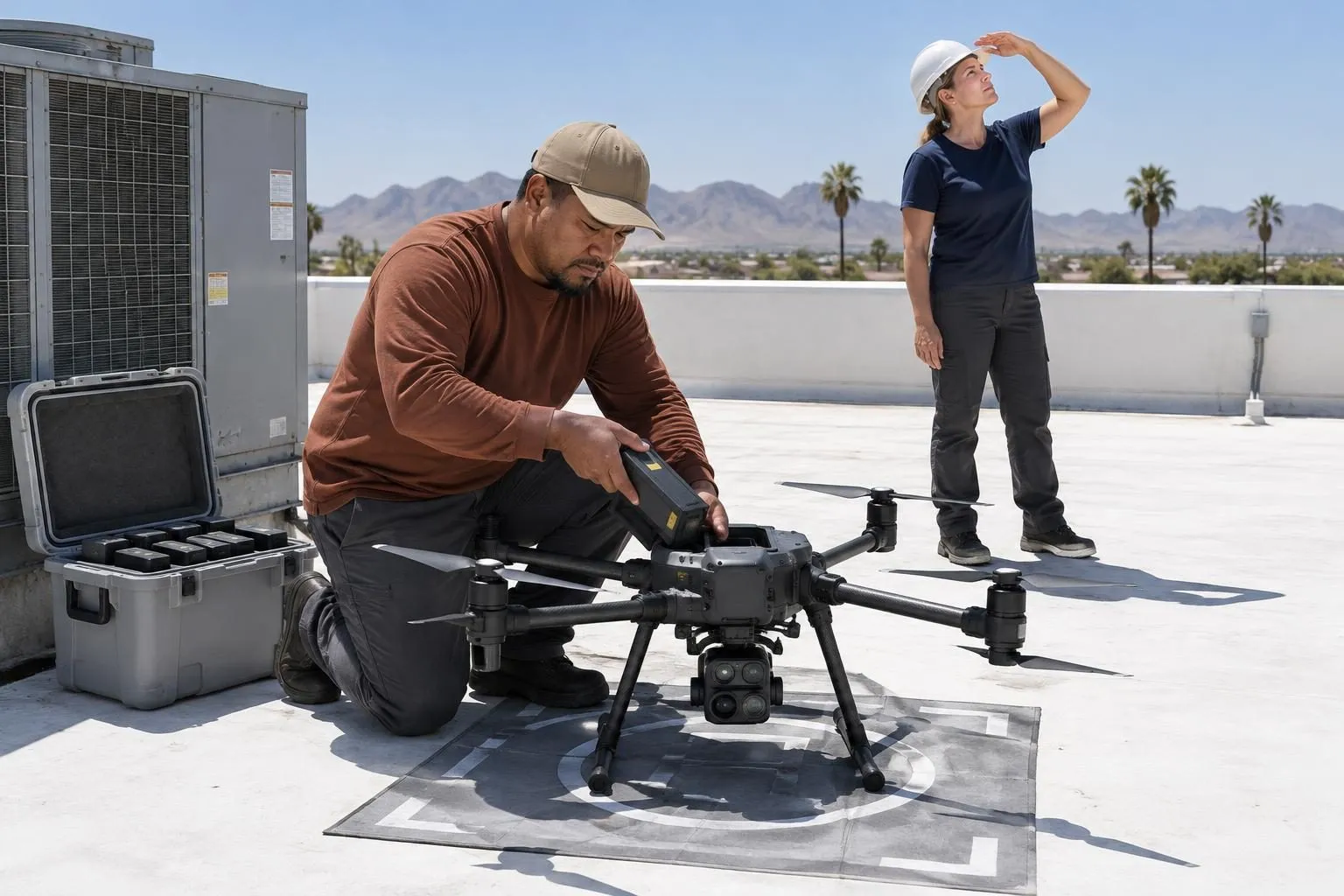
What happens: The operator shows up with standard-capacity batteries for a three-building industrial roof survey. Halfway through building two, they’re doing battery swaps in suboptimal positions, flying compressed routes, and skipping overlap on transitions.
Extended-life batteries or hot-swap capable models cost more upfront — but on industrial jobs that overlap justifies itself. Route planning has to account for battery limits, not the other way around.
| Battery Approach | Best For | Risk |
|---|---|---|
| Standard capacity, no spares | Small residential inspections | Mission abort mid-structure |
| Multiple standard batteries | Mid-size jobs with downtime tolerance | Cold batteries, interrupted workflow |
| Extended-life batteries | Long-duration industrial surveys | Higher upfront cost |
| Hot-swap capable system | Critical infrastructure, live documentation | Equipment cost, operator proficiency |
5. Flying in Marginal Weather and Trusting Sensors to Compensate
What happens: The client pushed to get it done before a deadline. The operator checked the forecast but not the wind-at-altitude data. At 200 feet the drone is fighting a 22-knot crosswind, the barometer is reading erratic altitude, and the stabilization system is doing its best work — which still isn’t good enough for sub-inch measurement accuracy.
Wind and humidity don’t just affect flight stability. They directly affect compass and barometer accuracy, which feeds directly into positional data. Over-reliance on sensors is a documented failure pattern. Manual piloting judgment has to come first.
Reality Check:“The drone has obstacle avoidance” is not a weather plan. Sensors are supplements to pilot judgment, not replacements for it.
6. Using the Wrong Camera for the Job
What happens: A contractor hires a drone service for a commercial roof inspection. The operator shows up with an RGB camera only. The actual problem — moisture intrusion around the HVAC curb flashing — is completely invisible in visible-light imagery. The report says the roof looks fine.
Thermal cameras for moisture and heat anomalies, multispectral for vegetation or solar array performance, LED-equipped for confined spaces with poor ambient light. Nobody tells you this upfront because most providers lead with “high-resolution imagery” and leave sensor selection to the client — who doesn’t know what they’re asking for.
Pro Tip:Before booking, tell the provider what decision you’re making with the data, not just what structure you need inspected. The answer changes what sensor they should bring.
7. Outdated Processing Software and No Quality Control Pass
What happens: The data comes back, the stitched model looks reasonable, and the report goes out. Six weeks later someone notices the point cloud has a 4-inch vertical offset that propagated through every measurement in the deliverable.
Photogrammetry software updates matter — newer algorithms handle edge distortion and overlap transitions better than builds from two years ago. GCP cross-referencing during processing isn’t optional; it’s the QC gate that catches systematic errors before the report leaves the building.
8. Ignoring Airspace and No-Fly Zone Verification
What happens: An operator plans a power-line survey, doesn’t check the temporary flight restriction filed two days earlier for a nearby utility maintenance helicopter, and either has to abort on-site or — worse — doesn’t abort.
FAA Part 107 certification covers the rules. Checking NOTAM databases and the B4UFLY app before every flight is the practice that keeps those rules from becoming an incident report.
9. Clients Who Don’t Define the Deliverable
What happens: The hiring side assumes the drone operator knows what “an inspection report” means to their workflow. The operator delivers a geotagged photo set. The client needed a thermal overlay with identified anomalies flagged by GPS coordinate. Both parties did exactly what they thought was agreed.
This is the most preventable mistake on this list and the one that generates the most re-do costs.
Specify: resolution requirements, sensor types, report format, coordinate reference system, turnaround time, and what constitutes a “finding” that needs to be flagged. Get it in writing before the drone leaves the ground.
Pro Tip:If you’re hiring for the first time, ask the operator to show you a sample deliverable from a comparable project. Seeing it is worth more than any scope document.
Practical Bottom Line
Most of these failures share a common root: assumptions substituting for process. Whether you’re the operator or the client, the fixes are the same — written checklists, explicit scope documents, and the discipline to treat calibration and GCP placement as non-negotiable line items, not time-consuming extras.
Before your next engagement, read through The Complete Guide to Drone Inspection Services to establish a baseline, then use this list as your pre-contract audit. If you’re on the hiring side, the nine questions embedded in these mistakes are also the nine questions worth asking any operator before you sign.
The tower crew from that first story got their inspection redone correctly two weeks later. It cost about three times what the original job did. The calibration check would have taken four minutes.
Done reading? Get quotes from drone inspection services near you.
Takes about a minute. Free, no obligation; providers reply to you directly.
Popular cities:
Nick built this directory to help general contractors and risk managers find FAA Part 107-certified drone inspectors without wading through generalist photography outfits that added a drone as an upsell — a conflict of interest he ran into when trying to document storm damage on a commercial roof and couldn’t tell which operators carried the commercial liability insurance to back their reports.